
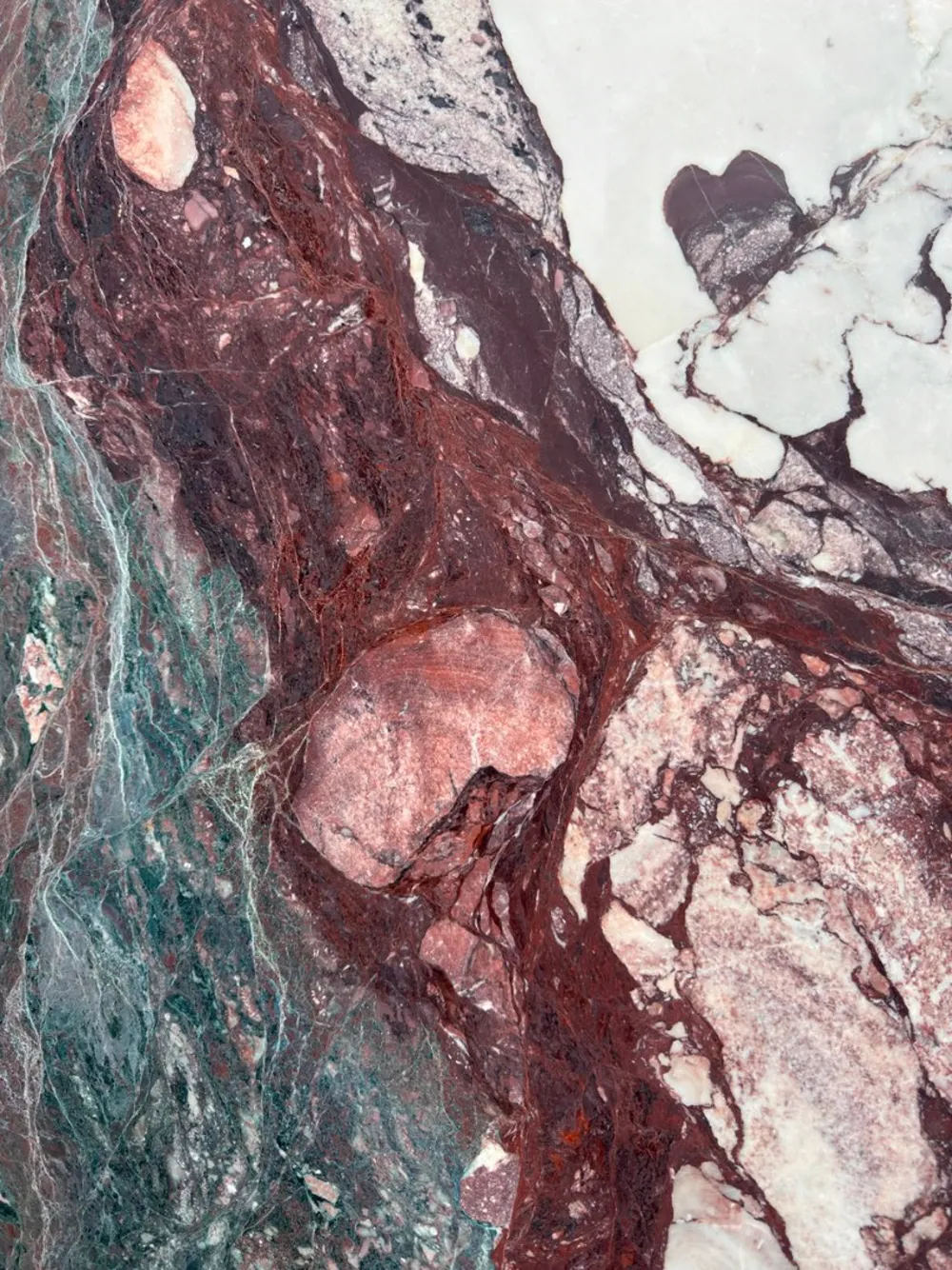
Bookmatched marble
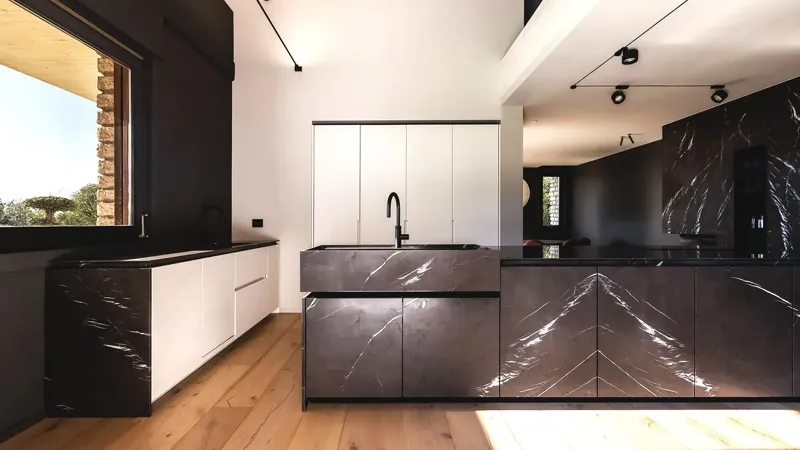
A cut block cannot be uncut. That is why design studios and fabricators entrust us with the bookmatching of walls, bathrooms, showers and kitchens: we digitize the exact slabs selected, show you the different options, and deliver exactly what you approved.
Like an open book
What is bookmatched marble?
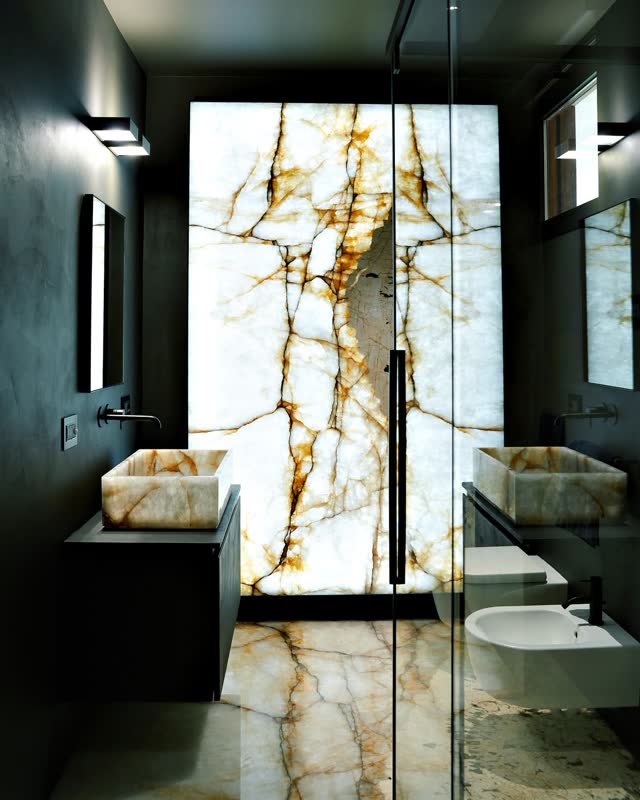
A block is cut. Two consecutive slabs come out nearly identical and, by polishing the opposite faces, they can be set mirror-to-mirror: the veining reflects along an axis and a new pattern is born.
The name recalls the pages of an open book — or a blot of paint pressed between them. In Italian the technique is called macchia aperta.
The scale of the pattern
Two slabs are a pair. Thirty are a project.
Two slabs are the classic pair: a single axis, the figure closing at the centre. Four slabs double the symmetry — one vertical axis and one horizontal — and generate the diamond figure known as the butterfly: quadmatch or four-way bookmatch.
Beyond four, the real project begins: six, ten, thirty slabs for a whole room or a complete space. From there on, designing the order of every single slab is essential. The veining must continue from one wall to the next, turn the corners, pick up above and below a door and land aligned on the floor.
The compositions
The same slabs. Different patterns.
A pair of slabs has no single outcome. Changing the axis, the orientation or the portion used, the same stone produces different figures — and the choice must be made before cutting, while every road is still open. Below, three openings of the same amazonite, studied on scans of the real slabs.
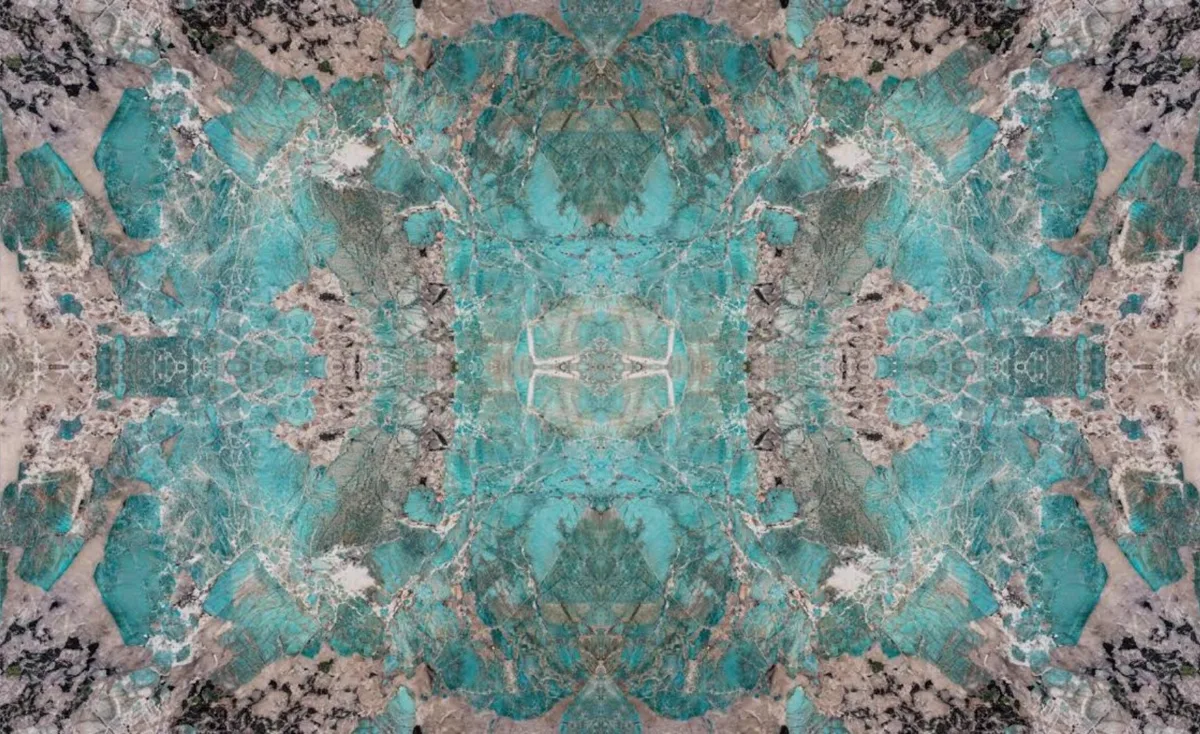
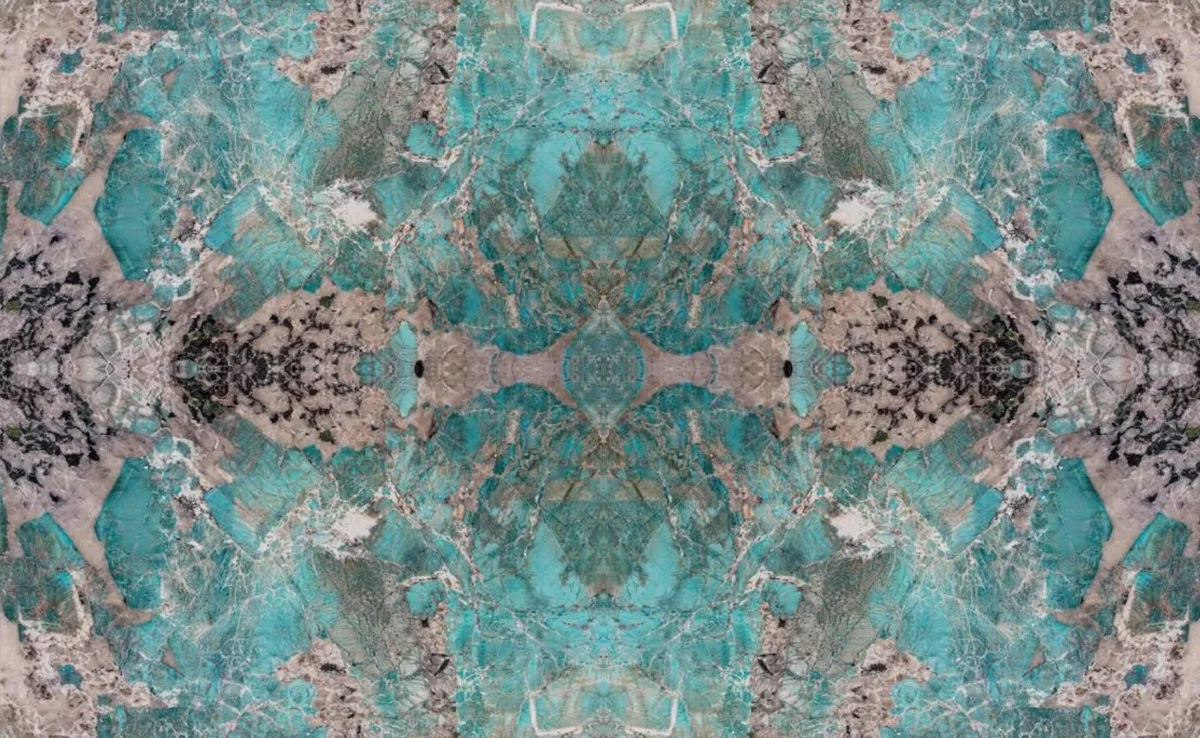
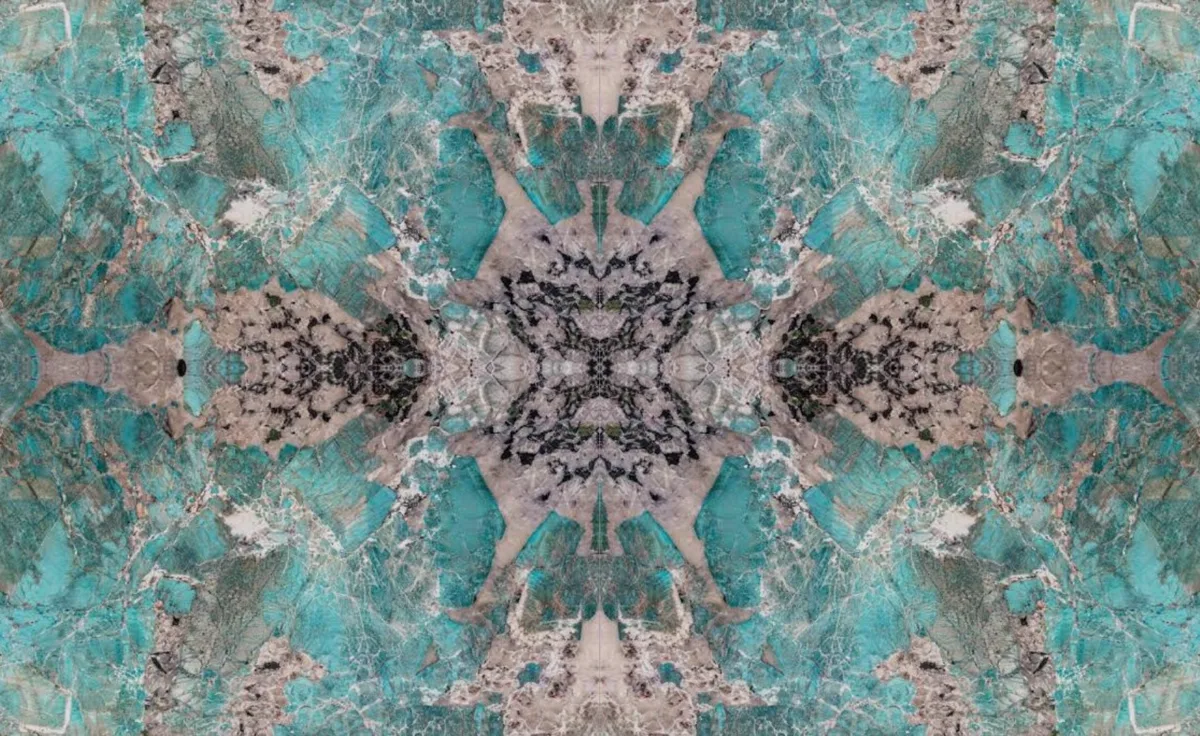
Version A — the slabs join on the right edge: the light part reaches the centre and the figure closes on itself.
The combinations are not infinite: the number and size of the slabs, the flaws to avoid, the direction of the vein and the geometry of the room narrow the field. It is a work of selection — which is why we prepare a few good compositions, not a hundred variants. Want to compare them on your project? Write to us.
The method
A bookmatch is not born on site. It is born in the design.
-
01
Project analysis
Dimensions, elevations, openings, corners and viewpoints: the wall is studied before the stone, because geometry decides where axis and joints can fall.
-
02
Selection at the warehouse
The slabs are chosen in person: a sound block, strong veining, consecutive cuts. Our warehouse in Verona, Italy holds over 2,800 slabs in more than 80 varieties.
-
03
Slab digitization
The exact slabs selected are digitized one by one. No stock imagery: what enters the design is their real veining.
-
04
Study of the openings
With the scans we compose several configurations — changing axis, orientation, opening side, portion — and compare them within the design, with true dimensions and joints.
-
05
Cutting, mirror polishing, numbering
Cutting follows the approved nesting: controlled sequence, opposite faces polished, and every slab numbered for the one place it will occupy in the pattern.
-
06
Dry lay and installation
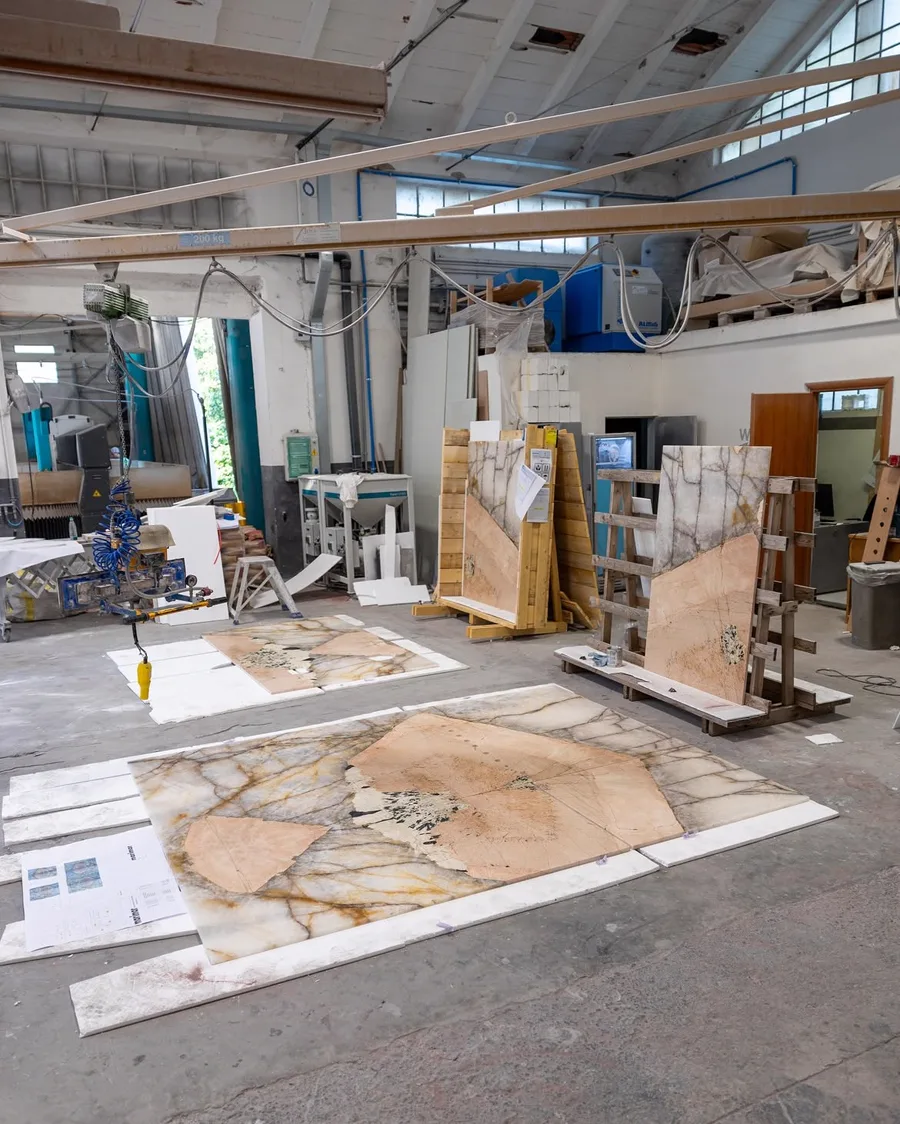
Before shipping, the whole composition is reassembled on the workshop floor and checked joint by joint.
The design
You approve an image. You receive exactly what you approved.
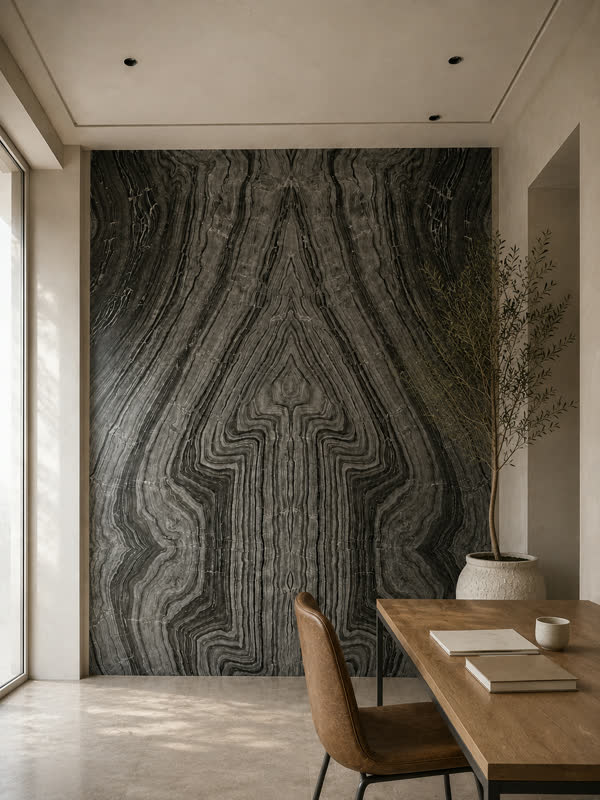
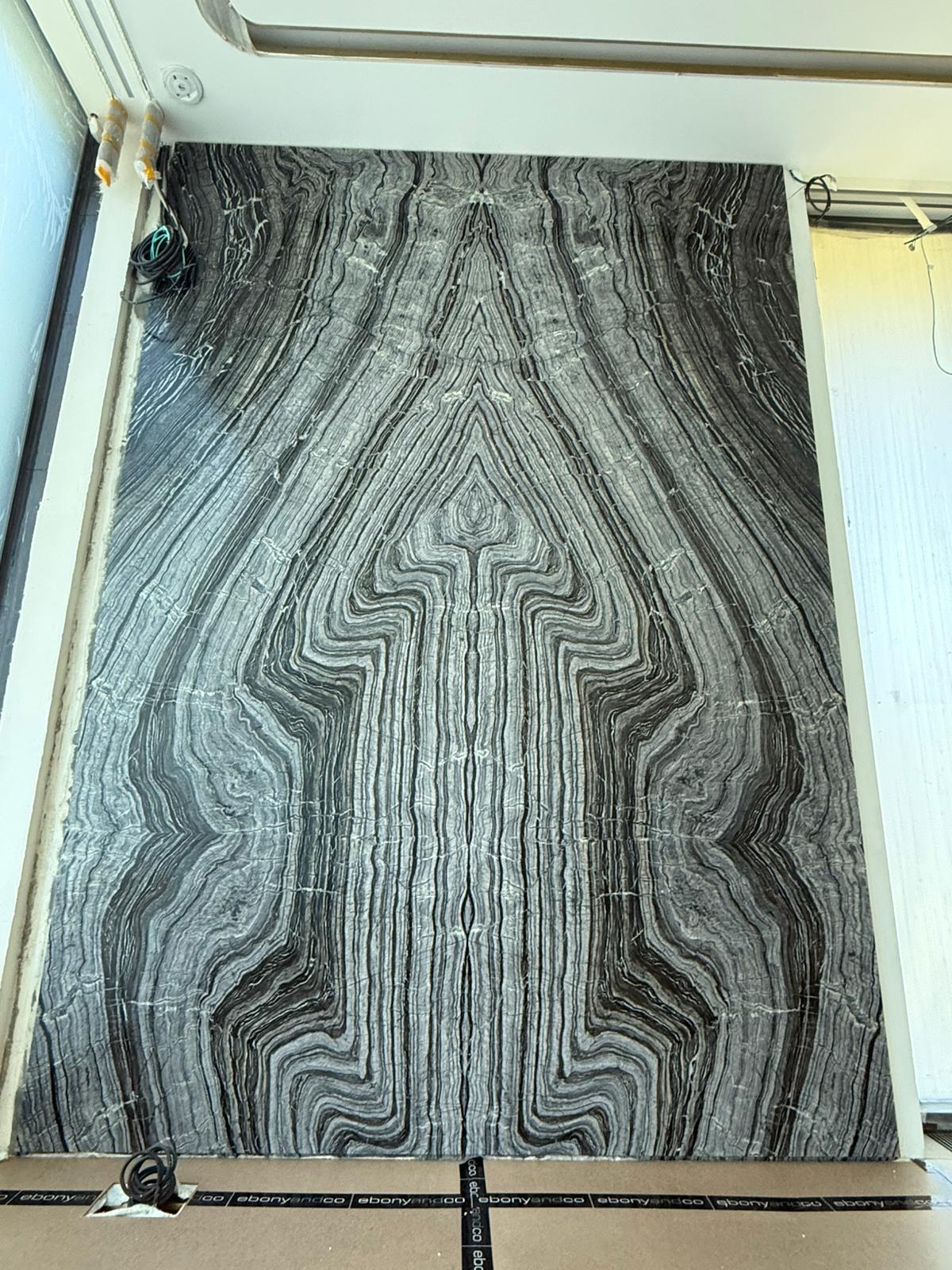
When we build the render of your project, the image we present is not indicative: it is the exact representation of the final result. The specific slabs are digitized, scaled, adapted and used to draw the design. Even the cutting plan is already defined: what you approve is what you will receive.
Alongside, the same wall at both moments: the approved design and the photograph on site.
The check
Dry lay: we assemble everything on the floor before it ships.
Every slab goes to its place, in the order and orientation of the design, and the pattern reads in full. What we check:
- Sequence and orientation of every slab
- Vein continuity across the joints
- Colour matching from slab to slab
- Correspondence with the approved design
- Numbering for installation on site
The dry lay is part of the method on every major composition: you can see it in our completed projects.
Materials
Not every stone can hold a bookmatch.
It takes a stone with strong veining and a readable pattern: those are the ones that give a recognisable figure once mirrored. Uniform-grained stones, with no visible veining, produce an effect you can barely perceive.
- Onyx
- Calacatta
- Quartzites
- Forest Brown
- Irish Green
- Cosmic Black
Mirror or continuity
Bookmatch and vein match are not the same thing.
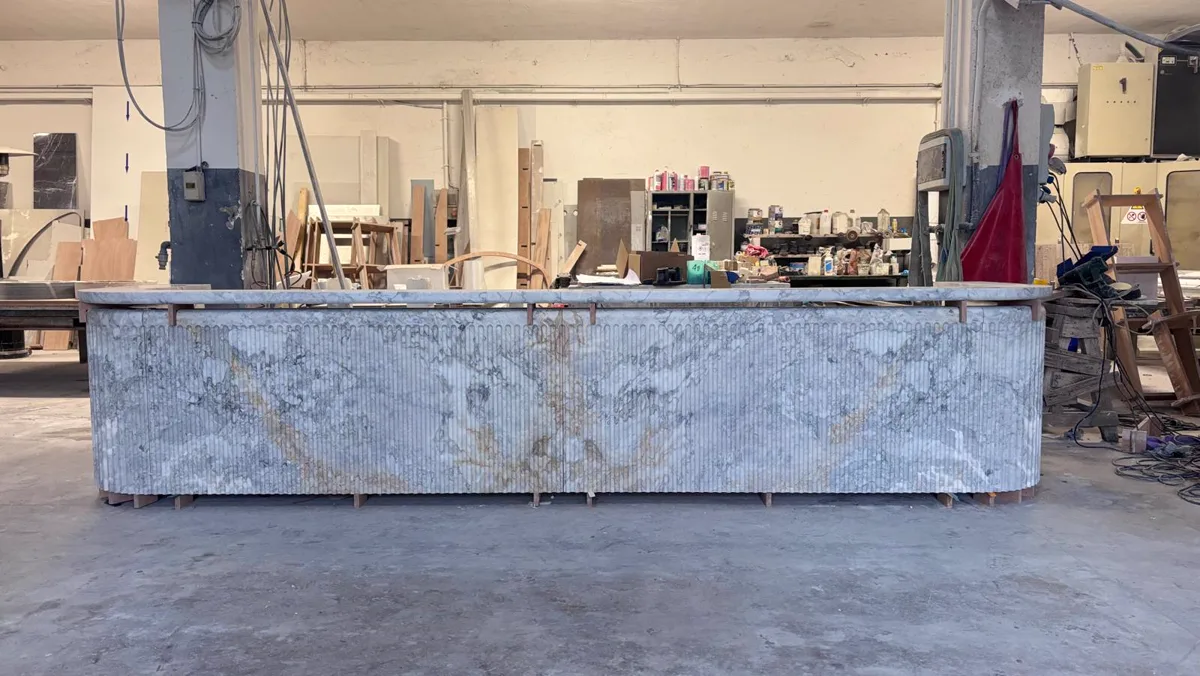
In a bookmatch the veining is mirrored across an axis and the pattern reflects. In vein continuity — vein match — the veining continues from one element to the next without mirroring. Both demand selection, design and control; they produce different results though, and many projects combine them: mirror on the focal wall, continuity on the elements around it.
Frequently asked questions
What we get asked most often.
-
None: they are the same process. Bookmatch and open book both describe two consecutive slabs of the same block set mirror-to-mirror, like the pages of an open book. In Italian the technique is called macchia aperta.
-
They are four-slab compositions: around a centre the symmetry becomes double — one vertical axis and one horizontal — producing the diamond figure, also called the butterfly. Depending on the configuration: four-way bookmatch, quadmatch or diamond match.
-
Yes. Only contiguous cuts of the same block have a pattern similar enough to mirror: two slabs far apart in the block, or from different blocks, will not match. That is why the material must be reserved in full before any cutting starts.
-
Anywhere from the two slabs of a shower wall to the dozens of slabs of an entire room, where the veining continues across every wall and the floor. The constraint is not the number: it is the sequence, because each slab can occupy only one place in the pattern.
-
No, and that is its authenticity: between one cut and the next the veining shifts slightly, so consecutive slabs produce a naturally mirrored pattern, with the variations that belong to real stone. The composition is studied and checked at every stage — design, cutting, dry lay — but it remains natural material, not a repeated print.
-
Yes: orientation, opening side, position of the axis, portion of slab and order of the sequence all change the figure. That is why we prepare several compositions from scans of the real slabs and compare them while choosing is still possible.
-
Yes. We digitize the slabs actually selected and compose them in the design, so you see the real veining in the position where it will appear; only after approval do we start cutting. After fabrication we reassemble the composition on the workshop floor — the dry lay — to check joints and continuity before installation.
-
Stones with strong veining and a readable pattern: onyx, Calacatta, quartzites, Forest Brown and high-contrast materials in general. Uniform-grained stones produce an effect you can barely perceive.
-
In a bookmatch the veining mirrors across an axis and creates a symmetrical pattern; in a vein match — vein continuity — the veining continues from one element to the next without mirroring. Many projects combine them: the mirror on the focal wall, continuity on the elements around it.
-
Yes. It is used above all on large vertical surfaces — shower walls, bathtub backdrops, kitchen backsplashes, panelling, headboards — but it also works on floors, where the mirrored pattern becomes the geometric centre of the room, and it can continue around the corners from one wall to the next.
-
The composition leaves the workshop already numbered and with its installation scheme, and we follow the project through to installation; the exact scope of the service is defined project by project. We also work with design studios and with fabricators who entrust us with the bookmatch stage alone.
You've chosen the marble.
Now let's choose how to open it.
Send us the drawing or photos of the material: we'll tell you whether the veining can hold a mirror, how many contiguous slabs it takes and how to set up the cut. We work with design studios and with fabricators who entrust us with the bookmatch stage alone.